CASE STUDY NO.3: How Owned Real Estate Impacts the Sale of a Business
For many business owners, the operating company and the commercial real estate it occupies and owns have grown together over decades. When it comes time to sell, it may seem logical to assume that selling both assets together will produce the greatest overall value.
But that is not always the case.
The relationship between a business and its real estate can significantly affect buyer demand, financing, valuation, deal structure, and ultimately whether the business itself can be successfully sold.
One engagement involving a long-established wine-industry business illustrates why real estate strategy and timing should be considered before either asset is exposed to the market.
A 30-Year-Old Business and a Valuable Specialized Property
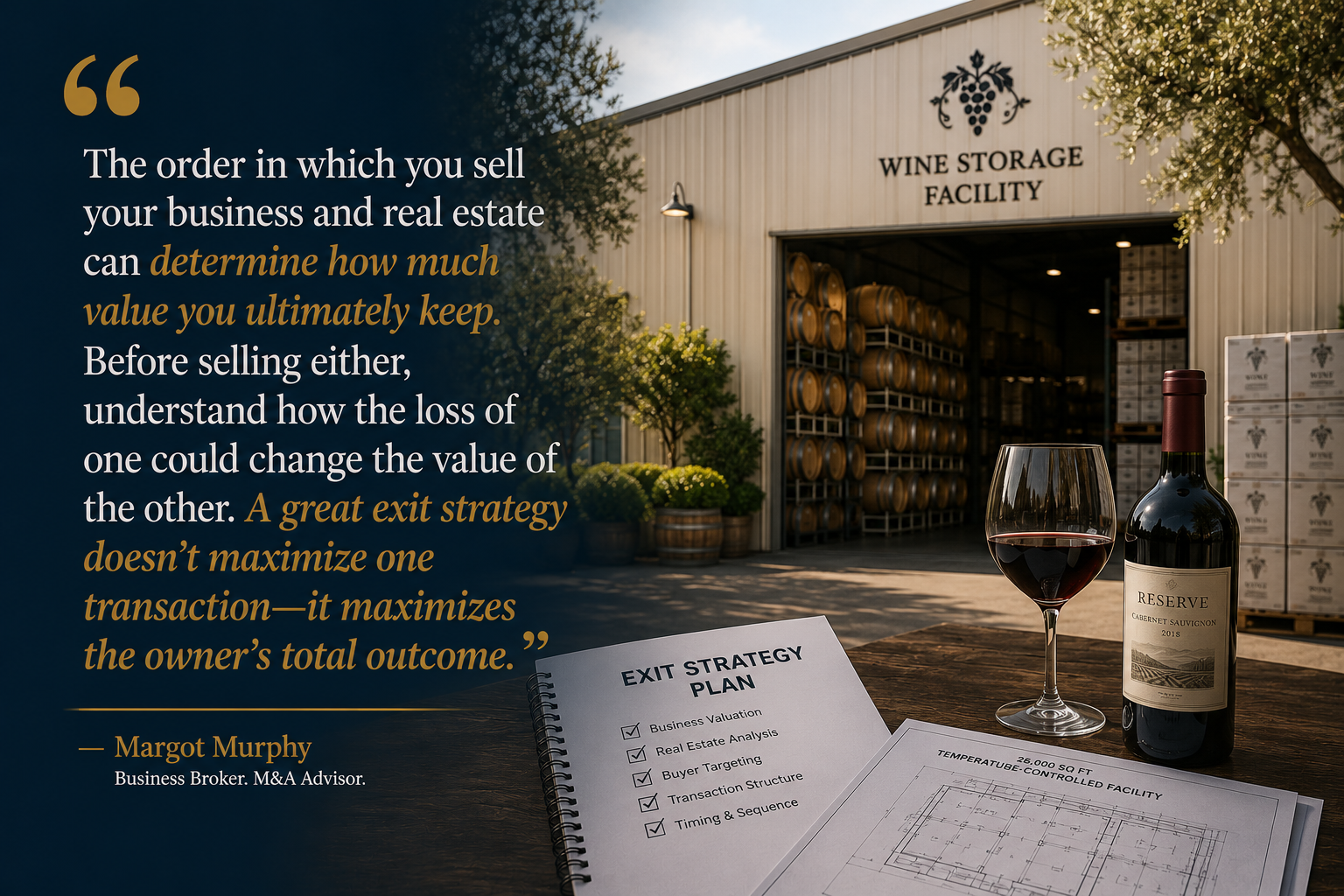
The seller owned both a specialized wine-industry business and the approximately 26,000-square-foot temperature-controlled warehouse facility from which the business operated in Temecula, California. The business had been operating for roughly 30 years and provided specialized services that included wine bottle label manufacturing, transportation and delivery, and storage of wine casks and substantial quantities of bottled wine. The owner intended to sell the real property, which had an estimated value of approximately $5 million. Because the business was deeply connected to the facility from which it operated, an important strategic question had to be addressed: Could a buyer be identified who would acquire both the real estate and the operating business?
Ideally, such a transaction could allow the seller to monetize both assets while preserving the business as a functioning operation. But before taking the opportunity to market, it was necessary to understand whether the economics actually supported that strategy.
The Financial Disconnect Between the Business and the Real Estate
The challenge was not simply the value of the property. The problem was the relationship between the value of the real estate and the income generated by the business occupying it. In this case, operating business did not generate sufficient income to support an ownership structure that would justify the approximately $5 million real estate value under a typical capitalization-rate analysis. This created a fundamental disconnect. The real estate had substantial market value on its own. The business had value separately.
For a buyer considering both assets, the total investment therefore became difficult to justify based on the operating performance of the business. This is where transaction strategy becomes critical. As their advisor, I looked beyond the individual values of the business and the property and ask:
How do these two assets affect each other when presented to the market?
Why Timing and Buyer Targeting Mattered
Before exposing either asset to the market, several possible outcomes needed to be considered.
- Could a strategic acquirer identify value in both the business and the specialized facility?
- Could another wine-industry operator benefit from acquiring the entire operation?
- Could an investor purchase the real estate while providing occupancy terms that preserved the business as a transferable going concern?
- Or would selling the real estate independently create consequences for the sale of the business?
These questions mattered because the sequence of the transactions materially affect value. The goal was to identify the optimum target acquirer and, if possible, source a buyer capable of acquiring both the approximately $5 million property and the operating business.
What Happened When the Real Estate Sold Separately
The real property was sold to a buyer other than the prospective buyer of the business. That transaction changed the business sale dramatically.
Ultimately, After the real estate was sold separately, a buyer of the business faced a very different situation.
A new owner of the business would potentially need to:
- identify and secure a suitable replacement facility;
- relocate inventory, equipment, and specialized business functions;
- manage the cost and operational risk of relocation;
- preserve customer relationships and service continuity throughout the transition.
The acquisition was no longer simply the purchase of an operating business. It had effectively become the purchase of a business combined with a relocation project. That additional cost, uncertainty, and execution risk materially diminished the attractiveness and value of the business.
For this mildly successful, approximately 30-year-old operation, the loss of its established real estate location proved detrimental to the intended business-sale outcome.
The Critical Lesson: Real Estate and Business Value Cannot Always Be Separated
Owning commercial real estate can create substantial wealth for a business owner. Yet, for some businesses, location and facility are part of the operating value of the company itself. This is especially true when the business depends on specialized infrastructure, storage conditions, zoning, logistics, equipment, customer accessibility, or operational configurations that may be difficult or expensive to reproduce elsewhere.
Selling the property first may unlock real estate value. But if doing so forces the operating business to relocate—or creates uncertainty about its future location—it can simultaneously reduce the value of the business that remains.
That tradeoff needs to be understood before going to market.
Key Questions Owners Should Ask Before Selling
- Can the operating business financially support the value of the real estate it occupies?
- Would a combined acquisition make financial sense to the most likely buyer?
- Is there a strategic acquirer who may value the business and property differently from a traditional financial buyer?
- How dependent is the business on its current facility?
- What happens to the value of the business if the property is sold first?
- Could a sale-leaseback or other occupancy structure preserve business value?
- Should the business and real estate be marketed together, separately, or through a coordinated process?
- Most importantly, what sequence of events is most likely to maximize the seller’s total outcome across both assets?
There is no universal answer. The correct strategy depends on the economics of the business, the market value of the real estate, the operational dependence between the two, the likely buyer universe, financing considerations, and the seller’s ultimate objectives.
Final Thoughts
A successful exit is rarely about determining what the business is worth and what the real estate is worth as two separate values.
The more important question may be:
How does the disposition of one asset affect the value and marketability of the other?
In this case, a valuable commercial property and a long-established operating business were economically connected, even though they could be sold separately. Once the real estate was sold to a different buyer, the business inherited a relocation challenge that materially affected its attractiveness to prospective acquirers. That is why business owners who also own their commercial real estate should begin exit planning well before going to market.
The right strategy requires understanding the business, the property, the likely buyers, the financing, and the sequence in which each component should be presented to the market. Because maximizing an owner’s exit is not simply about achieving the highest price for one asset. It is about protecting and maximizing the total value of everything the owner has spent decades building.
Your legacy deserves the right buyer—and the right strategy.